Do you play in your daily life? What says “playtime” to you?
My playtime isn’t a daily event. It happens when I can fit it in with caregiving duties. But when I can, I try and get a hike in.
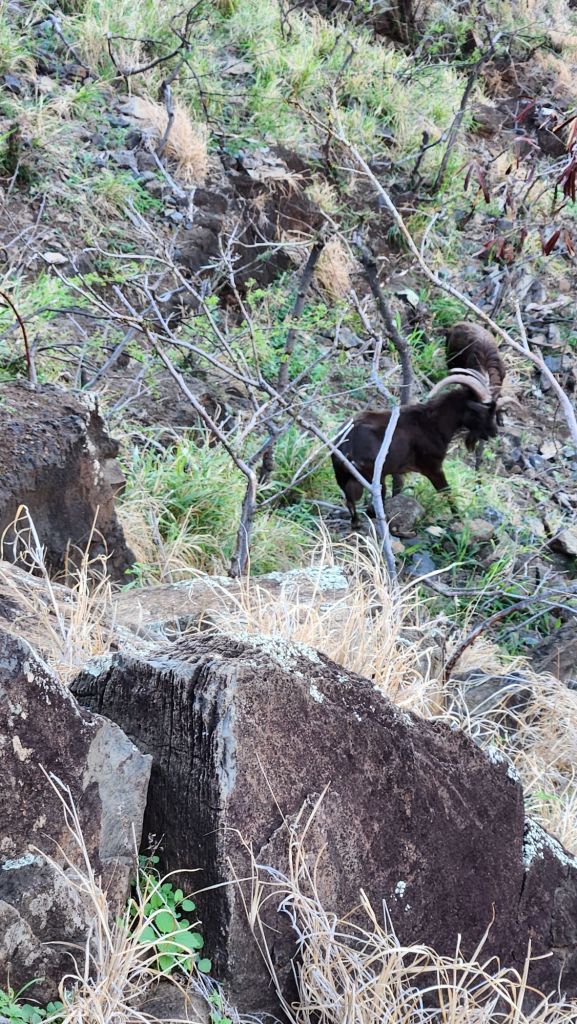
This New Year’s Day, I planned it well and went on my annual hike with my cousin, E, to Maili Pillbox. It was a beautiful day, perfect for a hike.
The feral goats were out. Someone brought up a Christmas tree and decorated, too. The blue of the ocean and sky was amazing. I love starting my year with a hike, and Maili Pillbox is always great. It makes waiting for “playtime ” worth it.
I started this post last night while lying in bed after my dad woke me up at 2am. I heard someone in the kitchen moving around, and I got up to see who it was. I expect to see my mom as her dementia has been fussing with her internal clock, and she wakes up at all hours in the early morning. But instead, I found my dad in a state. He asked me what was going on. I didn’t understand what he was talking about. He said why did I wake him up. I told him I didn’t do that. I was sleeping. I take it he didn’t believe me and went back to his room mad at me.
Well, this just added to my bad mom day, and going back to sleep took a while. I tried to compose this post in my head but refused to get up and start writing on my computer.
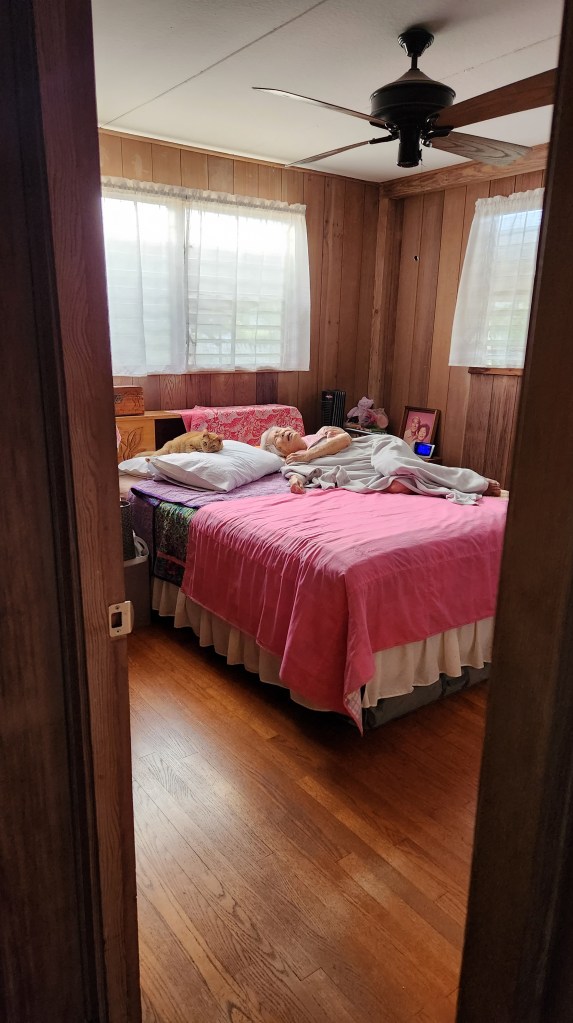
Mom’s day reminderMom and Orange taking a nap
Besides composing my post in my head, I started to think about how things are probably changing in my life. I think my parents (my mom, for sure) are entering a new phase of dementia. Mom has changed at a rapid speed, and I think she is now in the middle stage. My dad has been stable for quite a while, but I think Mom’s changes have stressed my dad to have this episode last night.
I have appointments for my parent to join an adult daycare group two days a week. I hope it’s not too late for my mom. My hope was the added stimulation of people and activities would help my parent’s dementia or at least slow it down. I also looked forward to having time for myself. I should stay positive that they are okay to join. It is so hard to see her change so quickly.
I’m trying to keep myself busy so I don’t get into a caregivers funk. It is really hard not to let it get to you. I’m do a lot of handwork, it some how keeps the anxiety a bay for me. I’m working on quilt #6, making a pouch for my double points, and knitting on the Noro scarf. Here’s some pictures of my progress.
hand stitching bindingattaching bindingcutting bindingquilt backquilt top
Quilt #6 for a friend
getting ready to hand quiltMamo print, batting, denimMamo print
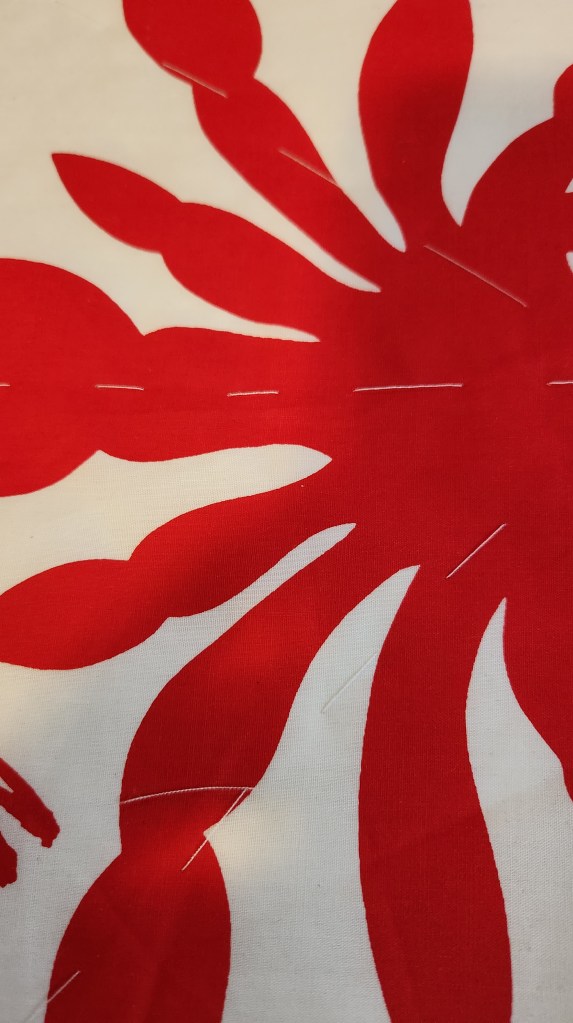
Zipper pouch for my double point needles. Using a Mamo print scrap with denim for the rest of the pouch. Quilting the scap as a Hawaiian quilt patch.
Noro scarf still goingMy little helper
I’m still working on my Noro scarf. I’m kind of feeling like it is endless. I’m aiming for the end of the year to finish it up.
I guess that’s it for now. I probably could on and on. But I’ll stop here for now. I need to run out and do some errands while the caregiver is here.
I started walking in the afternoon with six of my girlfriends from high school three times a week. Let me preface the fact that it is our 45 class reunion this year.
What started as something to get me moving has turned into a weekly catch-up on life, food and recipe exchange, and overall fun hour with friends I’ve known from junior high or even earlier.
For me, it gives me a break away from my folks and time to blow off some steam from a day of caregiving. We all are going through some kind of parental situation as we are at that age. It is always nice to have people who understand, give advice, and laugh with you.
I am sharing a project I started from the scraps of the donation quilts I’ve been working on. The fabric for the donation quilts comes from the adult bibs from the hospital’s acute care facility. The hospital’s volunteer crafter created them but didn’t need them anymore. I eventually got them to reuse as material for donation quilts to sell at the hospital’s thrift shop.
My pile of bibs in multiple stages of trimmings
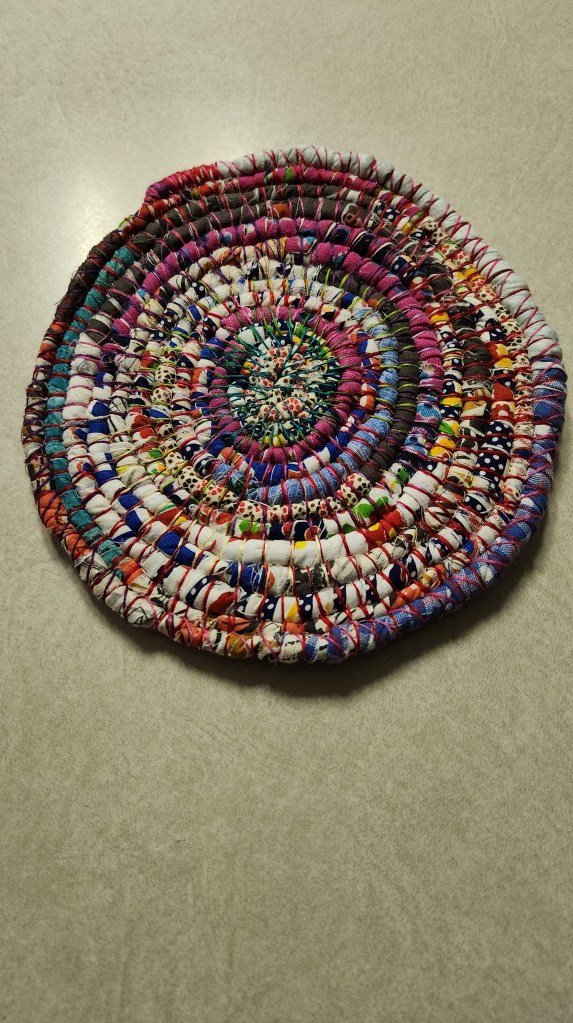
For the donation quilts, I trimmed off the neck area and the finished edges to get a large area of fabric to cut my pieces. I had about 20+ bibs, which makes for much trimming waste of the bib’s neckties and finished edges. I thought I could make wrap cord bowls or trivets from the trimmings. It’s like a version of my denim seam trivet I made during the pandemic.
my pile of trimmingswrapping and stitchingturning the sides
This is definitely a form of slow stitching.
I used the neckties (bias tape) as a cord, then wrapped and twisted the strips of fabric from the finished edges around them. I stitched around the wrapped cord to secure and connect the rows. I laid the wrapped cord on top of the previous row to build up the sides. I ended it by folding it under itself and stitching it tight so it would come apart.
Where my embroidery floss livesplus a trivet
Two finished pieces
There is still a bunch of trimmings left and more to make. I hope I can use all of it. Reuse, Reduce, Recycle.
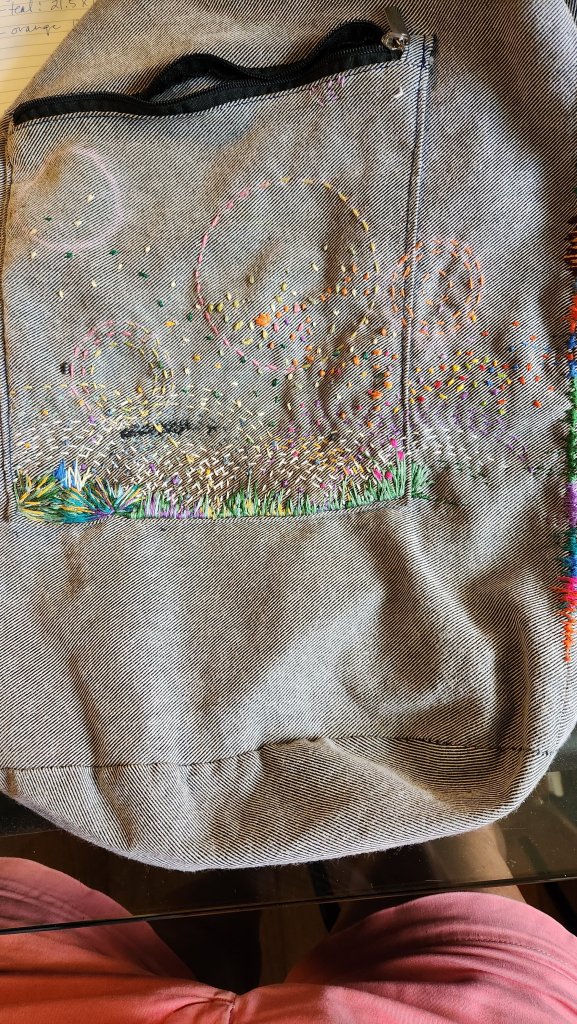
My on-going project-repairing my slouchy hippie bag.
I’ve started slow stitching to keep my hands while I care for my elderly parents. Caregiving is the toughest job I ever had. It is extremely stressful because of dementia.
I needed something to take my mind off stress and keep me in the present. My on-going project is a slouchy hippie bag that I’m repairing with patches and stitching.
Covering up the stains with stitching.
It’s just random stitching, leading itself from one type stitching to another. No big plans, not ever sure when I will know if it’s done. As long as it helps me quiet stressful noise of caregiving.